Atlantic Puffins

A Landmark Success Story

BIRD BRAINS: Inside the Strange Minds of Our Fine Feathered Friends (ISBN: 978-0-7267-8755-5)

by

Budd Titlow

http://www.buddtitlow.com

Many years ago, as part of the National Wildlife Federation’s Family Summit in Maine, I visited a very special place in the annals of avian conservation, Eastern Egg Rock Island. It was here in 1973 that Dr. Stephen W. Kress of the National Audubon Society started the now world-famous “Puffin Project.” Its objective was restoring Atlantic puffins to historic nesting islands in the Gulf of Maine (at the time, Atlantic puffins nested only on Matinicus Island and Machias Seal Island), where they had been wiped out by hunters in the nineteenth century. 
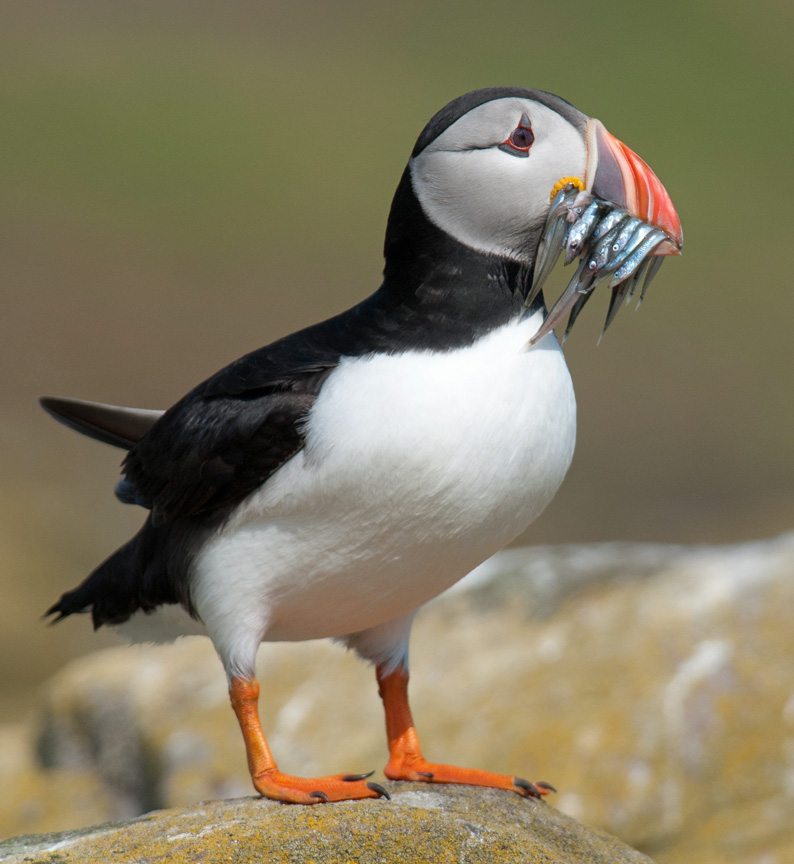
With a mouthful of freshly caught fish, an Atlantic Puffin (Fratercula arctica) returns to its nesting site on a remote island in the Gulf of Maine. 

Famed Maine naturalist and photographer Allan Cruickshank provides this wonderful description of the Atlantic Puffin: “This clown-like alcid with its dignified upright posture, its trim black and white plumage, its oversized gaily colored red, blue, and yellow bill, and its deliberate rolling pigeon-toed walk is the favorite among many bird-watchers.” 

Atlantic puffins have historically lived and nested in the North Atlantic, from New England to Canada, Iceland, and the British Isles. In much of their range, puffin populations are doing quite well. In fact, in many Iceland restaurants, puffin is a featured menu item.

If you’re looking for an introductory bird to get children interested in bird-watching, the puffin is a perfect choice. With their colorful bills and penguin-like bodies, puffins have been dubbed “sea parrots” and “clowns of the oceans.” Plus they use their short, stubby wings like propellers and large, webbed feet as rudders to expertly fly under water—diving to depths of more than two hundred feet, where they catch small fish like herring, capelin, hake, and sand eels. Finally, they use backward-pointing spines on their tongues and roofs of their mouths to catch and hold up to thirty fish at a time. 

For the Puffin Project, under Dr. Kress’s watchful eye, Audubon biologists transplanted two-week-old puffins to artificial burrows dug under the Eastern Egg Rock’s granite boulders. They also served as surrogate parents, by regularly delivering small fish—the puffins’ staple diet—to the burrows. A few weeks later, the first brood of Eastern Egg Rock–introduced puffins took to the skies to spend the next two to three years of their lives at sea. 

Although previous studies had conclusively shown that puffins always returned to the islands where they hatched, Kress’s researchers had no way of knowing for sure if these transplanted puffins would follow protocol. So during the next few years, they continued to transplant, feed, tag, and release puffins on Eastern Egg Rock.

Now here’s where things really get really interesting: In a precedent-setting move that rocked the birding world, researchers populated Easter Egg Rock with puffin decoys made out of plywood and mounted on boulders along the edge of the shoreline. Their bold ploy worked: In 1977 puffins began returning to the island, often landing next to the wooden decoys and pecking at their hand-painted beaks.

During the intervening years, the Puffin Project has proven so successful that each puffin hatched on Eastern Egg Rock becomes part of the Adopt-a-Puffin Conservation Fund, which supports long-term continuation of puffin research and seabird habitat preservation in the Gulf of Maine.

Text excerpted from book: Bird Brains: Inside the Strange Minds of Our Fine Feathered Friends, written by Budd Titlow and published by Lyons Press (an imprint of Globe Pequot Press).

Photo Caption & Credit: © Randy Rimland/Shutterstock.com

Author’s bio: For the past 50 years, professional ecologist and conservationist Budd Titlow has used his pen and camera to capture the awe and wonders of our natural world. His goal has always been to inspire others to both appreciate and enjoy what he sees. Now he has one main question: Can we save humankind’s place — within nature’s beauty — before it’s too late? Budd’s two latest books are dedicated to answering this perplexing dilemma. PROTECTING THE PLANET: Environmental Champions from Conservation to Climate Change, a non-fiction book, examines whether we still have the environmental heroes among us — harking back to such past heroes as Audubon, Hemenway, Muir, Douglas, Leopold, Brower, Carson, and Meadows — needed to accomplish this goal. Next, using fact-filled and entertaining story-telling, his latest book — COMING FULL CIRCLE: A Sweeping Saga of Conservation Stewardship Across America — provides the answers we all seek and need.Having published five books, more than 500 photo-essays, and 5,000 photographs, Budd Titlow lives with his music educator wife, Debby, in San Diego, California.
American Flamingos

Just Lawn Ornaments in the US

BIRD BRAINS: Inside the Strange Minds of Our Fine Feathered Friends (ISBN: 978-0-7267-8755-5)

by

Budd Titlow

http://www.buddtitlow.com

While living in Florida, I became very fond of flamingos. Problem is, these lean and lanky pink shrimp-eaters don’t really live wild in the Sunshine State. Based on how often and prominently these birds are displayed on postcards and as souvenirs, out-of-state visitors get the idea that wild flamingos live all over Florida! From a distance, they do look a lot like roseate spoonbills, large pink birds that are found throughout the state. American or greater flamingos primarily nest and live in the other Americas—Central and South, as well as the Caribbean. 

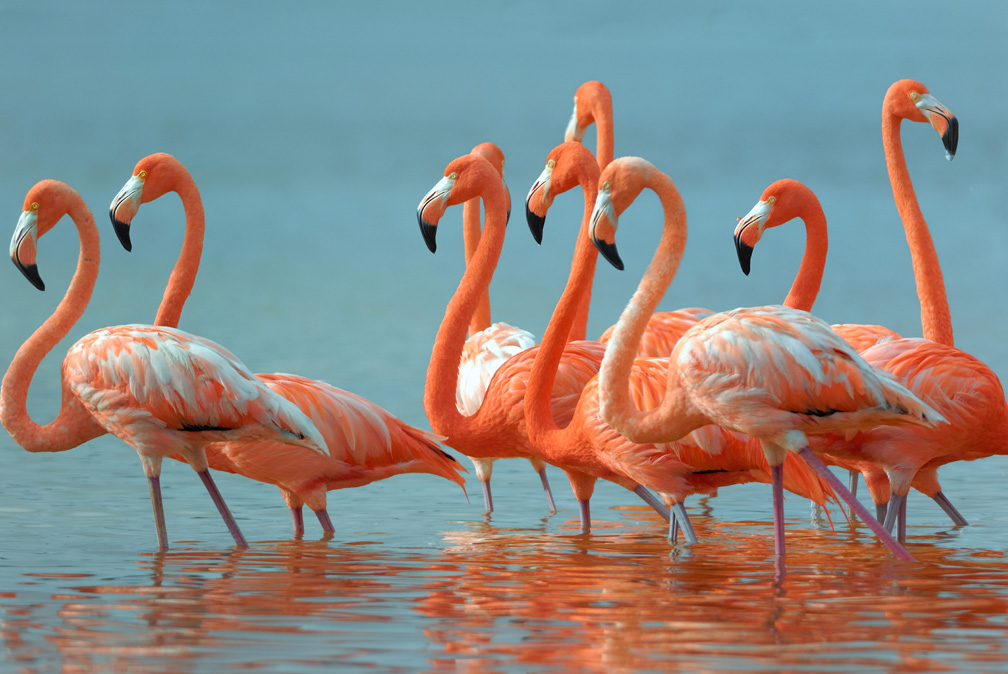
A flock of American Flamingos (Phoenicopterus ruber) feed on wild shrimp in a Mexican estuary. 

Oh a few Florida flamingos did manage to escape from a flock ill-advisedly introduced at Miami’s Hialeah Race Track way back in the 1930s. But now—with rare exceptions—the only flamingos in the state are captive either in zoos or theme parks. 

The name flamingo is derived from the Spanish word flamenco meaning “firey quality,” referring to the bright pink feathers that make these birds so instantly recognizable. Considered one of world’s ten most beautiful avian species, flamingos are actually found throughout the world with five separate species living in large colonies in the estuaries and saline lakes of Africa, Asia, and Europe as well as the Americas. Despite their delicately fragile appearance—with legs longer than the rest of their bodies, flamingos are actually pretty rugged individuals, living everywhere from hot volcanic lakes to icy waters in the Andes Mountains.

Another misconception—Flamingos do not spend a lot of time standing on one leg just to show off. They do this to conserve energy and body heat by keeping one foot at a time warm. Adult flamingos stand six feet tall, with spindly, pink, stilt-like legs that have forward-bending ankle joints located where knee joints would be on any other bird. They also have sprawling webbed feet that they use to scare the bejabbers out of shrimp, crabs, and other critters crawling around on muddy pond bottoms. Wedge-shaped heads with beady yellow eyes and broad, bent beaks sit high atop their S-curving necks. This is so flamingos can hold their breath, dunk their heads underwater, turn their bills upside-down, and swoosh their heads from side-to-side while looking backwards. 

Sound like a contortionist in a circus sideshow? Yes, it does look pretty silly, but it’s actually how these wacky-looking birds eat. Flamingos are filter feeders just like humpback whales. They sweep their heads along the bottoms of shallow ponds and lakes, trapping water and food in their mouths. Then they use their tongues to force the water out through comb-like structures called lamellae—equivalent to the baleen lining a whale’s mouth—trapping the food which they then gulp down.

So the next time you’re sightseeing in Florida, don’t expect to see large flocks of flamingos standing around everywhere. Not unless you want to count those flamboyant pink lawn ornaments, which, by the way, aren’t native either. Don Featherstone, a sculptor from Massachusetts, invented them in 1957—just check for his signature under the statue’s tail!

Text excerpted from book:          BIRD BRAINS: Inside the Strange Minds of Our Fine Feathered Friends, written by Budd Titlow and published by Lyons Press (an imprint of Globe Pequot Press). Photo credit:   Copyright Zixian/Shutterstock.com

Author’s bio:     For the past 50 years, professional ecologist and conservationist Budd Titlow has used his pen and camera to capture the awe and wonders of our natural world. His goal has always been to inspire others to both appreciate and enjoy what he sees. Now he has one main question: Can we save humankind’s place — within nature’s beauty — before it’s too late? Budd’s two latest books are dedicated to answering this perplexing dilemma. PROTECTING THE PLANET: Environmental Champions from Conservation to Climate Change, a non-fiction book, examines whether we still have the environmental heroes among us — harking back to such past heroes as Audubon, Hemenway, Muir, Douglas, Leopold, Brower, Carson, and Meadows — needed to accomplish this goal. Next, using fact-filled and entertaining story-telling, his latest book — COMING FULL CIRCLE: A Sweeping Saga of Conservation Stewardship Across America — provides the answers we all seek and need. Having published five books, more than 500 photo-essays, and 5,000 photographs, Budd Titlow lives with his music educator wife, Debby, in San Diego, California.

Albatrosses

Sailors Beware, Heed the Ancient Mariner!

BIRD BRAINS: Inside the Strange Minds of Our Fine Feathered Friends (ISBN: 978-0-7267-8755-5)

by

Budd Titlow

http://www.buddtitlow.com

In his classic narrative poem “The Rime of the Ancient Mariner,” Samuel Taylor Coleridge tells us in no uncertain terms that bad things happen when we mess with an albatross. 

From high school English class, you may recall that the albatross comes to save the wayward ship and crew from peril in Antarctica. The ungrateful Mariner then shoots and kills the albatross with his crossbow, whereupon the ship is becalmed for days on end and the sailors begin dying of thirst as told in the poem’s best-known line, “Water, water, everywhere, nor any drop to drink.” 

The sailors become so enraged at the Mariner for killing the albatross and forever cursing their ship that they make him wear the dead albatross around his neck to illustrate the burden he must suffer for killing it. Through the years, the fate of the Ancient Mariner has led to the contemporary colloquialism about how someone who endures a lot of bad luck in life has an “albatross around his neck.” 

Birds of the open oceans, albatrosses are primarily Southern Hemisphere species with only three species breeding north of the equator. They excrete salt from the seawater they take in through exceptionally long nostrils, giving them the nickname “tubenoses.”

A pair of Albatrosses (Diomedea spp.) on their nest in Ecuador’s Galapagos Islands.

With wingspans that can exceed eleven feet—the longest in the world—they have an incredible ability to stay at sea for months, even years, on end, often flying millions of miles in a fifty-year lifetime. Renowned as the most awesome oceanic birds on the planet, they are magnificent flyers as John James Audubon so eloquently describes in this passage:

 Albatrosses will always be associated in my memory with the ocean storms, with the plunging of the ship over mountainous seas and with the whirr of racing propellers over the crests of mighty waves. Amid all the grandeur, excitement, and danger of a storm at sea the albatross glides calmly on, rising easily over the crests of the highest waves and gracefully sailing down the valleys between them, frequently lost to sight but never troubled or confused, thoroughly at home in its native element. What mariner would not respect the bird that shows such mastery of the sea in its wildest moods?

Albatrosses feed on squidfish, and krill by either surface seizing or diving to capture their prey. They have a habit of following fishing boats, picking up bits of garbage that have been tossed overboard. Unfortunately this scavenging practice has contributed to severe declines in albatross populations worldwide. When they dive after the bait on long-line fishing gear, they often become entangled on the hooks and drown. Other threats include loss of habitat, introduced predators on nesting islands, becoming tangled up in plastic waste, oil spills, and climate change.

Fortunately there are conservation activities aimed at protecting the albatross. In particular, the World Wildlife Fund is implementing real-world solutions to modify fishing gear, reduce the incidence of accidental by-catch of oceanic birds, and allow fishermen to fish smarter while helping maintain the health of our oceans. 

If we’re lucky, these measures will help us protect the albatross for future generations—saving us all from the fate of the Ancient Mariner.

Text excerpted from book:          BIRD BRAINS: Inside the Strange Minds of Our Fine Feathered Friends, written by Budd Titlow and published by Lyons Press (an imprint of Globe Pequot Press). Photo credit:   Copyright Budd Titlow, NATUREGRAPHS. 

Author’s bio:     For the past 50 years, professional ecologist and conservationist Budd Titlow has used his pen and camera to capture the awe and wonders of our natural world. His goal has always been to inspire others to both appreciate and enjoy what he sees. Now he has one main question: Can we save humankind’s place — within nature’s beauty — before it’s too late? Budd’s two latest books are dedicated to answering this perplexing dilemma. PROTECTING THE PLANET: Environmental Champions from Conservation to Climate Change, a non-fiction book, examines whether we still have the environmental heroes among us — harking back to such past heroes as Audubon, Hemenway, Muir, Douglas, Leopold, Brower, Carson, and Meadows — needed to accomplish this goal. Next, using fact-filled and entertaining story-telling, his latest book — COMING FULL CIRCLE: A Sweeping Saga of Conservation Stewardship Across America — provides the answers we all seek and need. Having published five books, more than 500 photo-essays, and 5,000 photographs, Budd Titlow lives with his music educator wife, Debby, in San Diego, California.
TERNS, TERNS, TERNS

by

Budd Titlow

http://www.buddtitlow.com

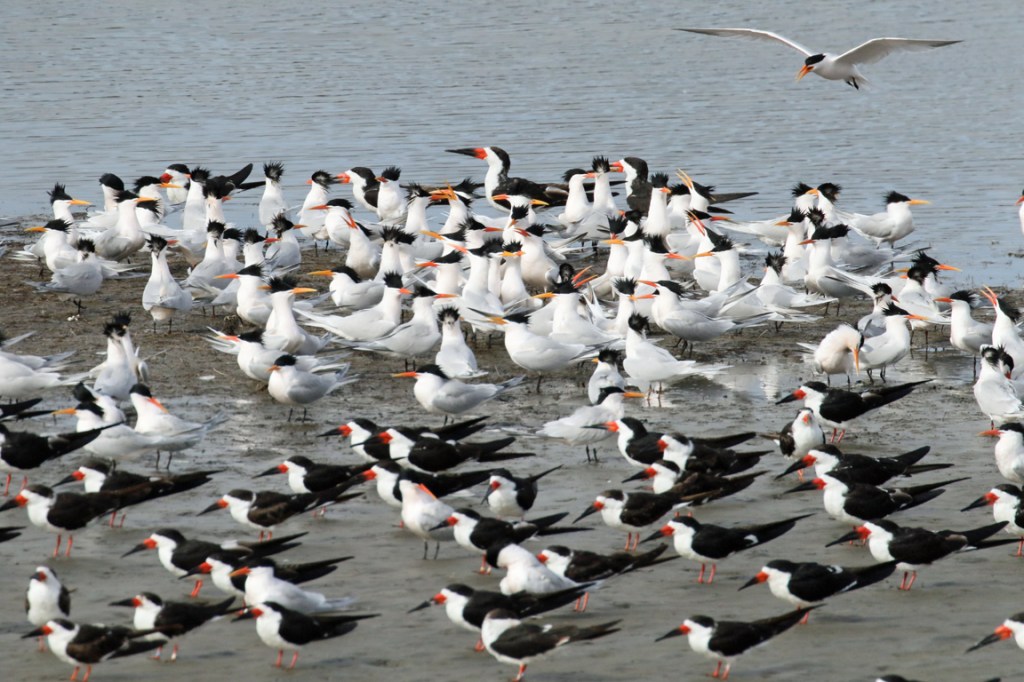
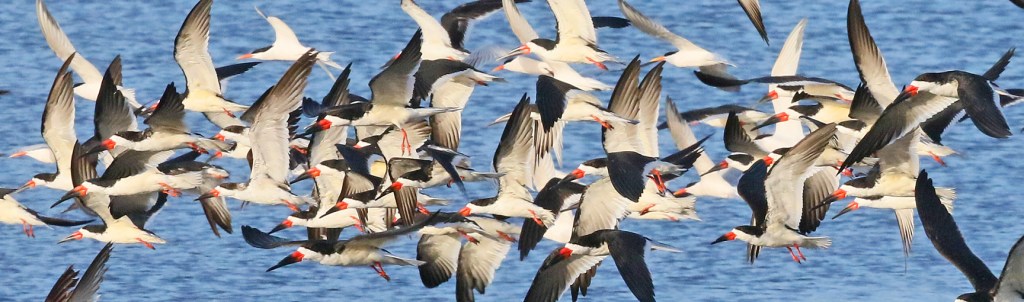
Mixed flocks of thousands of terns—plus their black skimmer cousins—were wheeling around and around in a screeching cacophony while performing their precision murmurations along both sides of the river channel. As a wildlife ecologist for almost 50 years—working throughout the United States—this was the most dazzling display of bird life I had ever seen.

Now for the back story—both the good and the bad components.

The setting for this avian spectacle was the “Southern Wildlife Preserve” section of the San Diego River Channel. A semi-professional wildlife photographer, I had been watching and photographing the interactions of 5,000 to 10,000 terns and 200 to 300 black skimmers for almost two weeks.

Every day, the same situation kept repeating itself. As the “cool dudes” of the river channel, the black skimmers—after a busy day of scooping their food—would all settle down together on a tidal flat. Aligning themselves in perfect formation, they all sat placidly with their heads facing directly west into the wind. 

Black skimmers resting in tidal flat with bodies all facing into the west wind.

Then the chaos started. First a few terns—from among the thousands that were also perched in the river channel—arrived and landed right in the middle of the skimmers. Now the key thing to remember here is this: Behaviorally, terns are the antithesis of their larger kin. They simply can’t sit still—much less all face in the same direction.

Terns “dropping into” the middle of a resting flock of black skimmers.

As more and more clusters of terns descended into the middle of the skimmer flock, the tension grew increasingly palpable. Something was about to happen soon … and then it did. Suddenly, the tidal flat seemed to rise up in a mass of whirring wings and deafening screeches. After five minutes of aerial cartwheeling and cajoling, the mixed flock broke apart and settled back down onto the tidal flats, landing in their separate colonies—groups of calm-and-collected skimmers and always agitated terns. Peace again prevailed—at least for 10 minutes or so until the terns again started trouble.

Mass liftoff of terns and black skimmers from a Southern Wildlife Preserve tidal flat.

While the skimmers were—no doubt—perplexed by the antics of their tern cousins, for beach visitors—birders and otherwise—this was a sight not to be missed. It was just like watching a Discovery Channel soap opera, with the laid-back skimmers as the “tight-knit family” being constantly harassed and befuddled by their ne’re-do-well tern “in-laws”.

Thousands of terns lifting off together and wheeling around the river floodplain in wide and wild screeching circles.

Tight groups of hundreds of black skimmers also lifting off and circling the floodplain with the tern masses.

Ok—so that’s the good news. Now for the sad part of the story. Unless some changes are made along the Dog Beach—Southern Wildlife Preserve boundary, this “must-see” wildlife spectacle may not be with us much longer.

Ecologically, the San Diego River Channel is a critical component of the Pacific Flyway which stretches from Alaska to Patagonia. The birding is especially good during the months of November through May. This is when thousands upon thousands of wading birds, shorebirds, gulls, terns, and pelicans spend time feeding in the channel’s tidal flats and shallow waters.

According to Lesley Handa, bird surveyor par excellence, “We have a unique combination of terns (six species) here in San Diego that occurs nowhere else on the planet.” During certain years, San Diego supports a large majority of the International Union for Conservation of Nature’s (IUCN) “near threatened” (NT) elegant terns that are endemic (restricted/native) to the pacific coast.

But here’s the problem: Unleashed dogs and wild birds just don’t mix well. This is because there’s no definitive demarcation between Dog Beach and the Southern Wildlife Preserve.

Everything is fine, as long as the unleashed dogs are restricted to the area officially designated as “Dog Beach”—which extends roughly 0.3 miles to the east of the high tide line. But the difficulty starts when the dogs venture into the prime bird habitat area—further to the east—along an area known as “Smiley Lagoon”.

Dogs being dogs, they love to chase anything that moves. Too often—starting at the western edge of Smiley Lagoon—this includes large flocks of feeding and resting birds. And—since birds are especially fragile when they are migrating—the presence of uncontrolled dogs in their essential feeding/resting habitat can be extremely detrimental.

So what’s the answer to this dog versus bird conundrum? Both types of animals have a right to occupy the west end—Dog Beach portion—of the San Diego River Channel: The dogs by virtue of a long-standing city beach designation, and the birds by virtue of migrating through San Diego County for thousands of years. 

But a solution may well be close at hand. There are already a couple of signs in the river channel stating “Notice—Approaching Wildlife Preserve”. These signs are mounted on sturdy 4×4 posts designed to withstand severe tidal surges.

First, these existing signs should be moved to the western end of Smiley Lagoon. Then the wording on these signs should be changed to read “NOTICE—Entering Wildlife Preserve—No Dogs Allowed”

Next, five or six more signs—also mounted on 4×4 posts—should be added. Finally, all the sign posts should be linked together by “sand-rope fencing”. This fencing would minimize visual/bird impacts while creating a definitive north-south boundary across the sandy (i.e., excluding the permanent water) part of the river channel.

Creating this low-key, sign-fence combination would be a classic “win-win situation” for everyone. The dogs would still have all of Dog Beach for romping and running. And the birds would have all of Smiley Lagoon—plus the tidal flats further east—for feeding and resting along their migration routes. 

Finally—for years to come—river channel visitors, like me, would be able to continue enjoying the thrill of watching thousands of terns filling the skies with their non-stop acts of avian derring-do.

Photo credits:       Copyright Budd Titlow, NATUREGRAPHS (ALL)

Author’s bio:     For the past 50 years, professional ecologist and conservationist Budd Titlow has used his pen and camera to capture the awe and wonders of our natural world. His goal has always been to inspire others to both appreciate and enjoy what he sees. Now he has one main question: Can we save humankind’s place — within nature’s beauty — before it’s too late? Budd’s two latest books are dedicated to answering this perplexing dilemma. PROTECTING THE PLANET: Environmental Champions from Conservation to Climate Change, a non-fiction book, examines whether we still have the environmental heroes among us — harking back to such past heroes as Audubon, Hemenway, Muir, Douglas, Leopold, Brower, Carson, and Meadows — needed to accomplish this goal. Next, using fact-filled and entertaining story-telling, his latest book — COMING FULL CIRCLE: A Sweeping Saga of Conservation Stewardship Across America — provides the answers we all seek and need. Having published five books, more than 500 photo-essays, and 5,000 photographs, Budd Titlow lives with his music educator wife, Debby, in San Diego, California.

GETTING PUBLISHED

by

Budd Titlow

http://www.buddtitlow.com

So … you’ve been an avid bird, outdoor, and nature photographer for several years.  Your shots always win compliments from family and friends and ribbons at local camera club competitions.  Now you want to move up to the next level and start selling your work.  How do you do this?

Getting Started

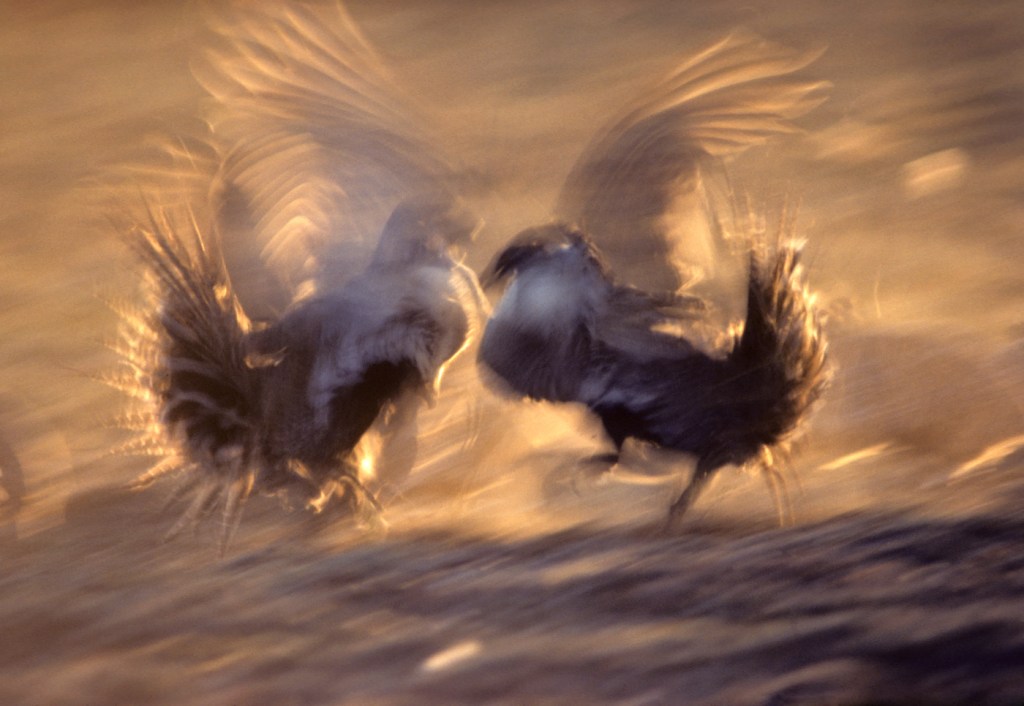
Male sage grouse embroiled in a territorial battle on a lek—mating ground—located in northwestern Colorado. (Photo Copyright Budd Titlow, NATUREGRAPHS)

Be realistic.  Don’t even think about quitting your day job—at least for a while.  The romantic allure of traveling the globe—camera in hand—is very enticing.  But unless you’re living off a trust fund, just hit the lottery, or have one‑in‑a‑million shots of mutant pygmy crocodiles in Borneo, it’s not going to happen.  You simply aren’t going to suddenly start making a living from nature photography.

Consider the facts:  The competition in the world of nature photography is incredibly fierce.  How can you compete with the likes of George Lepp, Art Wolfe, Frans Lanting, and other pros who can travel the world with $100,000 worth of camera gear and paid entourages? The answer: You’re not going to—at least not immediately!

So what do you do?  While the following suggestions may not make you rich, they will help you gear up for the world of photo marketing. If all goes well each year, you’ll be able to pay for equipment upgrades, travel to some exotic locations, earn a little extra sending money, and move your career along to future self-sufficiency.

Work your way up.  In many ways, the publishing world is a Catch22.  Editors like to see previous publication credits as verification of the quality of your work.  But if you haven’t been published, how do you break in?

Start small.  Chances are your first sales won’t be to National Geographic, National Wildlife, Audubon, or Outdoor Photographer.  But think about all the publications right there in your hometown or local area.  Town/city newspapers, conservation/corporate newsletters, city/regional/state magazines—most of these publications depend on freelance submissions.  They are always interested in well‑crafted photo-essays targeted for their audiences.  After you’ve got a few of these under your belt, then move up to the larger regional and national markets. 

Originality works.  Photo editors typically review thousands of digital files each month.  How do you make your work stand out from the rest?  First you have to build what I call a “foot‑in‑the‑door portfolio” of eye‑catching shots.  Then lead every submission with some of your showcase images.  In addition to getting an editor’s attention, they might wind up in places like Outdoor Photographer’s “Showcase”, Outside Magazine’s “Exposure”, or—who knows—even on a National Wildlife Magazine cover!

A Colorado sunset photographed through a giant salsify—oysterplant—seedhead. (Photo Copyright Budd Titlow, NATUREGRAPHS)

Remember, the one thing Lepp, Wolfe, and Lanting don’t have is your individual creative eye.  And the development of your creative vision doesn’t require trips to exotic locations or telephoto lenses that cost as much as compact cars.  It just requires a willingness to break the mold and try a few things that will set your work apart.  If you’re true to your own heart and personal vision, you will eventually be successful.  How can someone else market what only you can see?

Finding Ideas

Determine your marketing targets.  Whether you’re trying to publish a 1,000-word photo-essay or a 400-page book, you first need to decide who is most likely to be interested in your ideas. This means undertaking a comprehensive review of the magazine or book publishers who specialize in your preferred subject matter. I’ve found this is best accomplished by buying the most recent annual editions of both Photographer’s Market and Writer’s Market. If you’re an aspiring author/photographer, these two publications are literally worth their weight in gold. They provide you with the latest and most up-to-date information on each publisher’s contacts, preferred subject matter, what they are currently seeking, and how to format your submission. Both of these books are published by Writer’s Digest Books in Blue Ash, Ohio and can be ordered on-line directly from Amazon.

Photo-essays sell.  A picture may be worth a thousand words but words certainly help if you’re trying to sell the picture.  Editors love photographers who provide the complete package.  It makes their jobs a whole lot easier.  Learn to write crisply and engagingly.  Draw the reader in with fact‑filled text presented in a rapidly‑flowing, readable style.

Travel for Tips.  Nothing spurs the creative process like travel.  Anytime you go anywhere, think about unusual angles and perspectives that would make a good photo-essay.  Spectacular scenery, colorful characters, rare wildlife, local lore—anything is potential photo-essay material, if it’s presented with the right twist.  If you capture the essence of your trip in well‑crafted photos and words, you’ll definitely have some sales when you return home.  

This approach worked well for me during my early photographic years—living in Colorado.  Every time I returned from a weekend trip, I fired off several ideas to local magazines.  In less than a year, I was a contributing editor to both the Sunday Denver Post and Colorado Homes and Lifestyles Magazines

Making Submissions

To query or not to query.  The professional approach is to pitch your ideas to editors in brief—one page is best—“query letters”.  A query letter outlines your idea, tells why it would be of special interest to the publication’s readers, and describes your credentials for preparing the piece.  But when you’re first starting out, it’s difficult to get editors to bite on query letters.  Since they are “buying into” a piece when they give you the go‑ahead, they like to know what they’re getting.  If you haven’t published anything, it’s difficult to give them this comfort level—the old Catch22 strikes again!

So here’s a twist I recommend to bypass the Catch 22 when you first start out. If you think you have a truly marketable photo-essay, go ahead and bite the bullet. Prepare the complete text and accompanying photos—and then try to sell the whole package (instead of just writing query letters).  In fact, pull together several solid photo‑text packages and start sending them to your list of target publications (as developed from Photographer’s Market and Writer’s Market).  This way editors get to see exactly what they’re buying—with no guesswork on either side.  

Once you’ve sold a few pieces, especially to the same publication, then you have your “foot in the door”. Now you can start working on a query letter basis—pitching ideas first and getting editors to bite before you invest the time in pulling the pieces together.

Follow the publisher’s guidelines for submissions. Before you submit anything to one of the publications you have targeted, ask for their submission guidelines. You must make sure that you follow their specifications to the letter. Such things as digital styles and file sizes for your sample photos are critical to know. Approximate numbers of words and document formats are also critical to follow. Finally you need to know exactly how to submit your packages—e-mail addresses, name of receiving editors (if provided), etc. If your packages don’t follow specified submission protocols, chances are they may never even reach an editor’s desk.    

Don’t take it personally.  When a submission gets rejected—and believe me, many will—just immediately turn around and e-mail it to the next publication/editor on your list.  One thing the world of publishing will do is help you develop a very thick skin.  If you don’t handle rejection well, you might want to think twice about even trying to get published.  

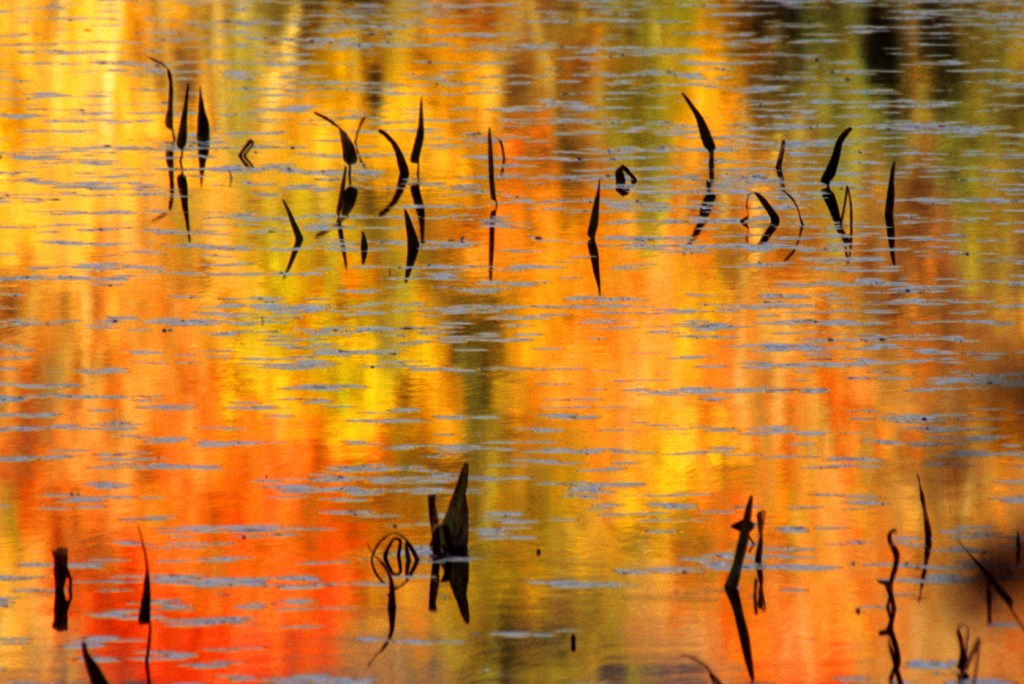
Reflections of fall foliage embolden a lake in New Hampshire’s White Mountains. (Photo Copyright Budd Titlow, NATUREGRAPHS)

But if you’re braced for rejection, the thrill of that first acceptance—which will inevitably come, if you’re persistent—is well worth all the disappointment that preceded it.  Few things in life can compete with the satisfaction of seeing your own photos and words in print!

These marketing techniques have worked well for author Budd Titlow during his 45-year career as a freelance nature photographer and author. To date, he has sold five books and more than 500 magazine/newspaper photo-essays, including an estimated 5,000 photographs. (Each of the three photos accompanying this blog has been published at least 10 times.)

Author’s bio:  For the past 50 years, professional ecologist and conservationist Budd Titlow has used his pen and camera to capture the awe and wonders of our natural world. His goal has always been to inspire others to both appreciate and enjoy what he sees. Now he has one main question:Can we save humankind’s place — within nature’s beauty — before it’s too late? Budd’s two latest books are dedicated to answering this perplexing dilemma. “PROTECTING THE PLANET: Environmental Champions from Conservation to Climate Change”, a non-fiction book, examines whether we still have the environmental heroes among us — harking back to such past heroes as Audubon, Hemenway, Muir, Douglas, Leopold, Brower, Carson, and Meadows — needed to accomplish this goal. Next, using fact-filled and entertaining story-telling, his latest book — “COMING FULL CIRCLE: A Sweeping Saga of Conservation Stewardship Across America” .

BICYCLE BIRDING

by

Budd Titlow

http://www.buddtitlow.com

If you are a bird photography aficionado, I have some great news! 

The proliferation of “Rails-to-Trails” conversion projects throughout our Nation has created a fantastic new modus operandi for practicing your passion. Plus, it also benefits your health by providing daily exercise. I call this activity bicycle birding and here’s how it works for me.

Four years ago as a retiree, I moved to La Jolla, California—just north of San Diego—to be near one of one of my daughters and three of my grandchildren.   As an avid—but not very adventurous bicyclist—I immediately began researching local bikepaths that offered long, flat rides along vehicle-free surfaces.  

First, I found a book that described all the bicycle trails in San Diego County. Then I selected those that met my desired criteria. Fortunately—as is now the case in just about every municipality—I found an array of suitable options.

Next, I started doing “test rides” to evaluate each of my selected bikepaths for bird photography opportunities. After about three months of field testing, I came up with a winner. A six-mile long, paved route paralleling the south side of the San Diego River provided me with both of my objectives—the optimal biking distance coupled with spectacular photo opportunities on almost every ride.

The other key to this endeavor was acquiring new camera gear—including a telephoto lens and camera combination that would allow me to capture high-quality, handheld images. (This was critical because—for me—biking with a tripod was not an option!) To accomplish these goals, I purchased a Canon EF 400mm f/4 DO lens and Canon EOS 7D Mark II camera.  

As it has turned out, these were the best photographic purchases I have ever made. Many of the birding photos (see attached) I have taken during the past four years are among my best in more than 40 years of outdoor photography.      

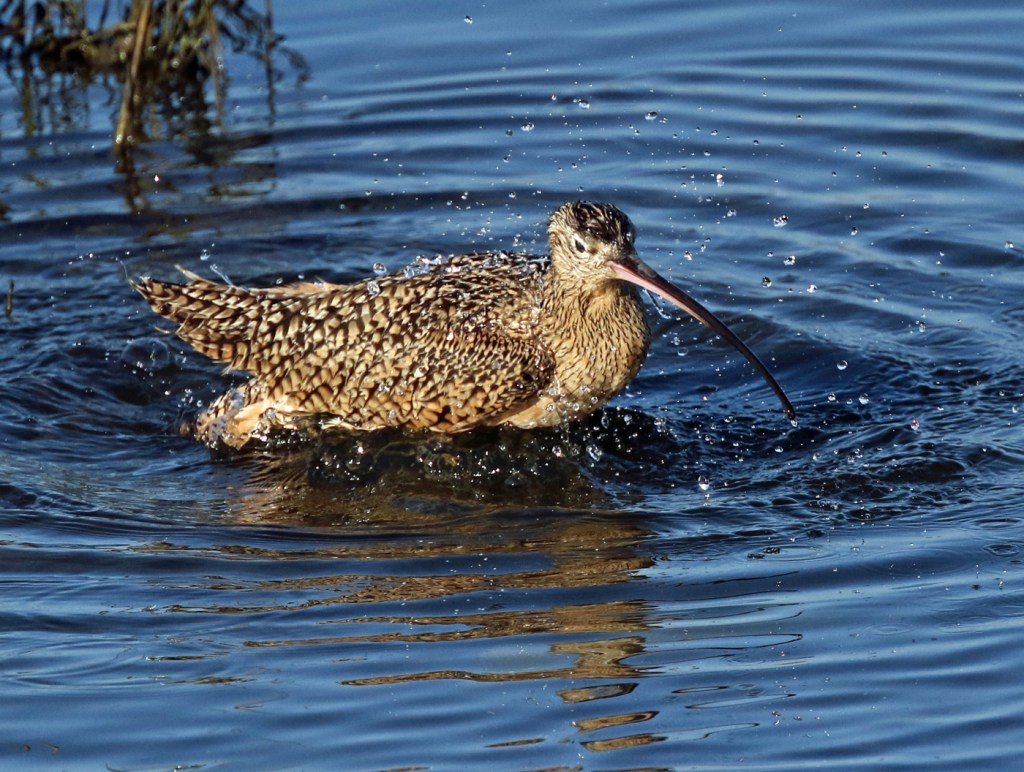
A long-billed curlew is preening and cleaning its feathers. (Photo Copyright Budd Titlow, NATUREGRAPHS)

A reddish egret holds a just captured fish. (Photo Copyright Budd Titlow, NATUREGRAPHS)

A snowy egret holds a freshly caught fish. (Photo Copyright Budd Titlow, NATUREGRAPHS)

A tricolored heron uses its wings to shade the water for better visibility. (Photo Copyright Budd Titlow, NATUREGRAPHS)

A male wood duck swims along while displaying its colorful feathering. (Photo Copyright Budd Titlow, NATUREGRAPHS)

A reddish dances across the water while pursuing a fish. (Photo Copyright Budd Titlow, NATUREGRAPHS)

A black-necked stilt pauses while feeding in a tidal flat. (Photo Copyright Budd Titlow, NATUREGRAPHS)

Now—on at least five afternoons a week—I throw my binoculars, camera, and lens into a sturdy backpack and I’m off to my favorite bikepath. I ride along the river until I see a bird or birding activity that I want to capture. When this happens, I pull off to the side of the path, grab my gear out of my pack, and fire away until I’m happy with my results. Then it’s on to the next photo opportunity that I see along the route. I typically make four or five stops during a 10-mile ride.  

As I mentioned at the start—because of the plethora of new bikepaths all over the country—you can find similar bicycle birding opportunities no matter where you live. Of course—the extent of time you can enjoy this activity—may be limited by climate. But you’ll always have some months—for example, during seasonal migrations—during which the birds and bird behaviors will be plentiful!

So, give it a try. I think you’ll agree that better health plus prize-winning bird photographs is a combination that’s hard to beat!

Photo credits:  Copyright Budd Titlow, NATUREGRAPHS (ALL)

Author’s bio:     For the past 50 years, professional ecologist and conservationist Budd Titlow has used his pen and camera to capture the awe and wonders of our natural world. His goal has always been to inspire others to both appreciate and enjoy what he sees. Now he has one main question: Can we save humankind’s place — within nature’s beauty — before it’s too late? Budd’s two latest books are dedicated to answering this perplexing dilemma. PROTECTING THE PLANET: Environmental Champions from Conservation to Climate Change, a non-fiction book, examines whether we still have the environmental heroes among us — harking back to such past heroes as Audubon, Hemenway, Muir, Douglas, Leopold, Brower, Carson, and Meadows — needed to accomplish this goal. Next, using fact-filled and entertaining story-telling, his latest book — COMING FULL CIRCLE: A Sweeping Saga of Conservation Stewardship Across America — provides the answers we all seek and need. Having published five books, more than 500 photo-essays, and 5,000 photographs, Budd Titlow lives with his music educator wife, Debby, in San Diego, California.


Wacko Wacha Woodpeckers

by

Budd Titlow

http://www.buddtitlow.com

I’ve been doing wildlife-birding surveys for 45 years and I’d never seen anything quite like it. The trunks of two large pine trees displayed row after row of neatly drilled small holes. Closer inspection revealed acorns carefully tucked into most of these holes.

The trunk of a large pine tree displays row after row of neatly drilled small holes with acorns tucked inside.

Curiosity got the best of me. I had to find out what was going on. I walked around to the base of the trees and — within minutes — I had my answer. A flock of about 10 woodpeckers — all clamoring wacha-wacha-wacha— descended on the tree trunks. For the next 15 minutes they flitted about the trees, noisily squabbling with each other and digging acorns and insect larvae out of the bark. Then they were off, only to return again 10 minutes later for another session of feeding and fighting.

A flock of woodpeckers — all clamoring wacha-wacha-wacha— descended on the tree trunks.

If you haven’t experienced the playful antics of acorn woodpeckers, you’re missing a treat. Their raucous antics have earned them the title of “clowns of the oak-pine woodlands”. In the U.S., the primary habitat for these birds is found in the coastal and foothill areas of Oregon and California with extensions into oak-dominated forests of the Southwest.

Belying its reputation for being among the “clowns of the oak-pine woodlands”, an adult acorn woodpecker poses quietly on the trunk of a dead “snag tree'”.

Acorn woodpeckers are robin-sized birds with harlequin-feathered faces perched atop black-and-white bodies. Their off-kilter laughing calls inspired the distinctive “voice” that Walter Lantz gave to his Woody Woodpecker cartoon character. 

Living in small (seven to twelve birds) family colonies, acorn woodpeckers exhibit some of the most extreme social behaviors found in the birding world. First and foremost is each colony’s diligence in establishing communal “granary trees” packed with acorns. Each fall during the peak of oak mast production, a colony of these woodpeckers begins drilling thousands of storage holes in the soft wood of large pines. Then — working cooperatively — the birds begin transporting acorns to their selected granary trees and carefully tucking them into the drilled holes. 

Often supplemented by fruit, insects, and sap, the acorns sustain the woodpecker colony through the often-severe winter weather where they choose to live. Throughout the fall and winter — as the acorns shrivel and shrink — each bird in a colony dedicates most of its daily hours to moving them around to different-sized holes for a tighter fit. If the acorns aren’t snugly maintained, they become easy targets for squirrels, Steller’s jays, scrub jays, and other such “cache robbers” to steal.

An adult acorn woodpecker holds the pupa of an insect that it just fished out of this tree bark.

With the onset of April each year, the nesting season begins and each colony’s behavior becomes even stranger. The living arrangements would intrigue even the most outlandish Hollywood producer. In a polygynous mating system, multiple males and females share the same tree nesting cavity in which they all breed together. Yes you read that right — it is basically an avian orgy. Then the female who lays the first eggs experiences the ignominy of having her eggs pecked apart and eaten by the colony’s other adults. In a bizarre twist, the egg-laying mother often joins on this soiree of feathered cannibalism. But —not to fear — after the first clutch is devoured, the nesting females all lay additional eggs which are then judiciously nurtured.

While this nesting process would make even Casanova blush, the end result is usually quite successful. That’s because all of the adult and sub-adult “helper birds” pitch in to make sure the hatchlings are kept well-fed, safe, and secure until they can fend for themselves.  

If you’re visiting San Diego County, acorn woodpecker colonies can be found throughout such high elevation locales as Laguna Mountain Recreation Area and Cuyamaca Rancho State Park. Based on my personal experience, these birds are extremely easy to find in both of these areas. Just keep your eyes peeled for the large granary trees packed with acorns. They’re just about everywhere you look — along roadsides and even bordering picnic areas and campgrounds. Once you successfully locate a few granary trees, wait for the wacha-wacha-wacha calls. Then watch as the sky fills with woodpeckers.

Photo credits:  Copyright Budd Titlow, NATUREGRAPHS. 

Author’s bio:     For the past 50 years, professional ecologist and conservationist Budd Titlow has used his pen and camera to capture the awe and wonders of our natural world. His goal has always been to inspire others to both appreciate and enjoy what he sees. Now he has one main question: Can we save humankind’s place — within nature’s beauty — before it’s too late? Budd’s two latest books are dedicated to answering this perplexing dilemma. PROTECTING THE PLANET: Environmental Champions from Conservation to Climate Change, a non-fiction book, examines whether we still have the environmental heroes among us — harking back to such past heroes as Audubon, Hemenway, Muir, Douglas, Leopold, Brower, Carson, and Meadows — needed to accomplish this goal. Next, using fact-filled and entertaining story-telling, his latest book — COMING FULL CIRCLE: A Sweeping Saga of Conservation Stewardship Across America — provides the answers we all seek and need. Having published five books, more than 500 photo-essays, and 5,000 photographs, Budd Titlow lives with his music educator wife, Debby, in San Diego, California.
A Remarkable Success Story

by

Budd Titlow

http://www.buddtitlow.com

Trudging through wind-blown sand, I headed toward what I hoped was the last umbrella on the beach. I hadn’t quite made it when I spotted a potato-sized ball of fluff merrily hopping toward me. Could this really be what I thought it was … or was I just hallucinating in the late spring sunlight?  

For many years, I have lugged my camera and telephoto lens along the edges of cordoned off dune and beach habitats. Always closely peering into these sandscapes, I’ve never found what I was hoping to see. But — this past June — everything changed. Looking beyond the solitary piping plover that had first attracted my attention, I saw something I could scarcely believe. The carefully fenced shorebird nesting areas of Ipswich, Massachusetts’ Crane Beach were suddenly alive with both piping plovers and least terns. I was in ecstasy … everywhere I pointed my camera I framed another good shot of these typically hard-to-find species. More than a thousand captures later, I met my daughter and headed back to my room at the Inn at Castle Hill to review my photos and research why things were — in my personal experience — suddenly so different.

While piping plovers and least terns are dramatically different in both appearance and activity, their breeding habitats share strikingly similar characteristics. This explains why they often occur together in the same nesting habitats and are both endowed with special state and federal protection statuses.

In breeding plumage, the sparrow-sized piping plover features bright orange legs and bill accentuated by big eyes and a sharp black collar. Meanwhile the nesting least tern exhibits a sleek body — built-for aerial derring-do —offset by a handsome black cap, notched across the eye, and a deeply forked tail.

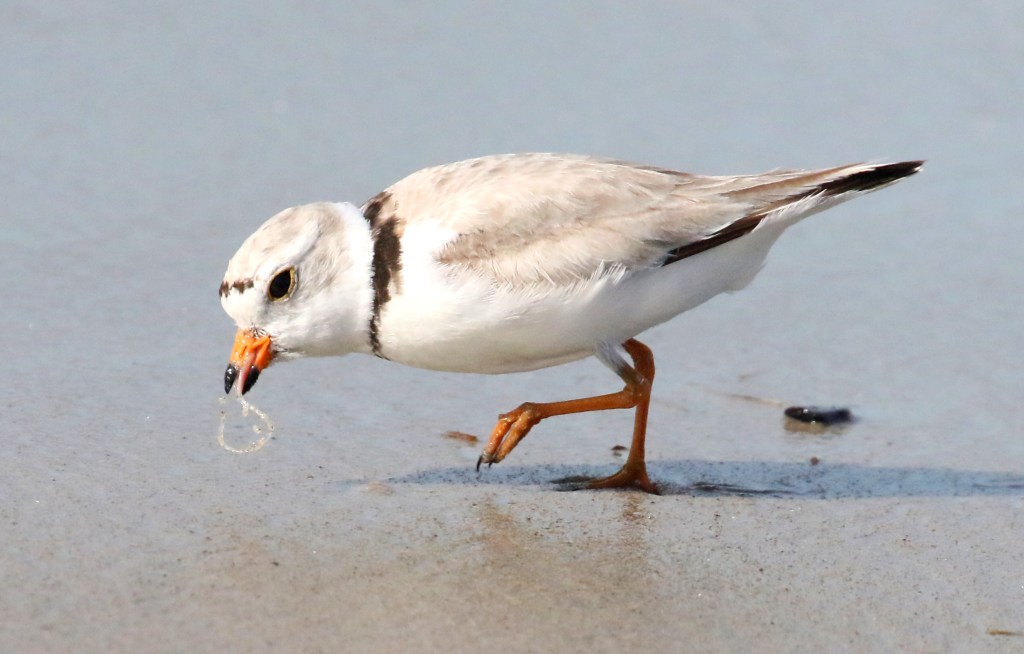
A piping plover is in the process of catching a marine worm for dinner.

When not on the ground, the least tern is constantly flying, darting this way and that, until suddenly hovering and then dive-bombing a small fish 50 feet below. Think of a miniature osprey and you’ve got the picture. Meanwhile the piping plover is a consummate skitterer, dashing helter-skelter through the dunes and then down into the tidal zone where it plucks tasty morsels for dinner. 

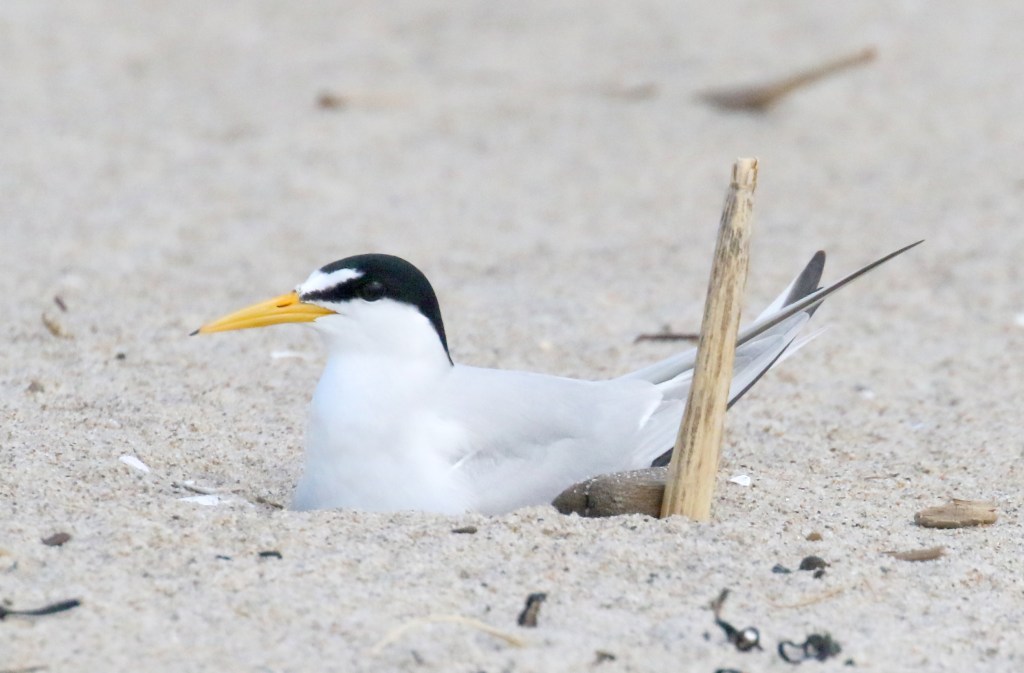
A least tern dutifully watches for predators while sitting on her shallow, sandy scrape of a nest.

Now for the nesting similarities: both piping plovers and least terns practice extreme simplicity in their domestic abodes. The males of each species make multiple shallow scrapes in the sand — generally away from vegetation — and then let the females choose the sites they like the best. Since camouflage is the goal for protecting both eggs and chicks, the adults typically move bits of shells and small pebbles into and around the nesting scrapes. And that’s it.

While nest construction is quite basic, nest protection is not. Both species eagerly and actively defend their nests from potential intruders. Piping plovers have been known to bite the fingers of interloping humans while least terns have earned the nickname of “little strikers” for their habit of dive-bombing people who come too close.

This brings us to the present and my recent gleeful experience with both of these dynamic little birds on a Massachusetts beach. Why are there now so many of each? The only way I can think to explain it is that both state and federal wildlife agencies are doing an incredible job. Their restrictions on human access to both species’ nesting areas must be really working.  So my hat is way off to all you hard-working biologists and ecologists. Please keep up the great work!

Photo credits:  Copyright Budd Titlow, NATUREGRAPHS. 

Author’s bio:     For the past 50 years, professional ecologist and conservationist Budd Titlow has used his pen and camera to capture the awe and wonders of our natural world. His goal has always been to inspire others to both appreciate and enjoy what he sees. Now he has one main question: Can we save humankind’s place — within nature’s beauty — before it’s too late? Budd’s two latest books are dedicated to answering this perplexing dilemma. PROTECTING THE PLANET: Environmental Champions from Conservation to Climate Change, a non-fiction book, examines whether we still have the environmental heroes among us — harking back to such past heroes as Audubon, Hemenway, Muir, Douglas, Leopold, Brower, Carson, and Meadows — needed to accomplish this goal. Next, using fact-filled and entertaining story-telling, his latest book — COMING FULL CIRCLE: A Sweeping Saga of Conservation Stewardship Across America — provides the answers we all seek and need. Having published five books, more than 500 photo-essays, and 5,000 photographs, Budd Titlow lives with his music educator wife, Debby, in San Diego, California.
BIRD BRAINS

Inside the Strange Minds of Our Fine Feathered Friends

ISBN: 978-0-7627-8755-5

By Budd Titlow

http://www.buddtitlow.com

A feeding group of white pelicans plies the waters of the Southern Wildlife Refuge at the mouth of the San Diego River.

Wild birds are my friends. I like talking to them. Nothing too deep, mind you. Just stuff like, “Well, hello there guys. How are you doing today? Beautiful weather we’re having, isn’t it? Your feathers are sure looking nice and fluffy this fine morning.”

And here’s the best part. I think the birds actually listen to me. They often talk—or more correctly, call or sing—back at me while I’m standing there watching them.

I did not always have such a copacetic relationship with birds. As a young boy, I roamed my rural Virginia neighborhood shooting them with my trusty Daisy air rifle (aka BB gun). But even John James Audubon shot and killed many thousands of birds. At the time (during the 1800s) it was the only way he could “collect” subjects to serve as models for his now world-famous and highly valued portraits of North America’s wild birds.

I myself limited my shooting to such undesirable, invasive birds as the English house sparrows and European starlings that liked to perch and nest on rooftops, leaving various and sundry messes in their wakes. I had a pact with my parents and my neighbors that I would never shoot any robins, cardinals, or other native songbirds.

Today, I cringe at the thought of the birds I killed. And as a homeowner myself now, I certainly would not tolerate some young boy wandering through my backyard, randomly picking birds off electric wires and rooftops.

Accompanied by my dad, I also engaged in the Southern tradition of duck hunting as a teenager in the Virginia mountains. While I do remember taking aim and firing off shotgun blasts at ducks flying overhead, I have no recollection of ever knocking a bird out of the air, much less actually killing one.

Fortunately, I ended my gun-toting ways when I matriculated to Florida State University and Virginia Tech to pursue graduate degrees in wildlife biology. Since then, I have never picked up another gun. When I moved to Colorado to begin my career with the federal government, I started hunting wildlife with a camera and telephoto lens—seeking color images to illustrate my freelance writing instead of stuffed and mounted trophies for my family-room walls.

As a professional wildlife biologist, part of my job always involved identifying as many birds as I could whenever I conducted a field assessment. I was highly envious of those who could readily idenftify every birdsong and call they heard. No matter how much I listened to the traditional bird song identification tapes—birdsong, bird name—birdsong, bird name—birdsong, bird name—on and on ad infinitumI just couldn’t get the hang of it. I just found them boring.

Then came my true epiphany as a birder. I discovered Richard Walton’s Birding by Ear program and my career as a serious birder was born. I suddenly began hearing and recognizing individual birdsongs out of the cacophony of sounds that flooded spring woodlands and summer fields. Before long, I was able to identify more than 90 percent of wild birds by songs and calls alone. Actually seeing them became just an extra added benefit. 

My identification skills—and thus my enjoyment—increased exponentially. Now it’s amazing to me how most people—even those with highly trained ears—don’t seem to hear or respond to individual birdsongs. To many, these wondrous sounds just seem to be part of nature’s background noise. In his book, Music of the Birds, nature recordist Lang Elliott eloquently describes it this way: “To the naïve ear, the sounds all mix together to create a pleasurable sensation, but this is like listening to an orchestra without knowing the musical instruments.”

My newfound expertise to hear, listen to, and identify wild birds any time I’m outdoors—no matter the time of day or the season of the year—allowed me to finally fully understand the widespread allure of bird-watching or, as it’s known to the purists, simply “birding.” According to US Fish and Wildlife Service, there are currently more than fifty-one million birders in the United States alone, and this number continues to grow annually.

To me now, birds are nature’s great communicators. They always let me know when they’re around—by both sight and sound. And they provide a window to the natural world, giving me open looks into the wide variety of natural habitats they call home.

This point was vividly driven home to me during a trip to Fort De Soto Park in Pinellas County (near St. Petersburg), Florida. Late one afternoon, I was standing near the end of the park’s long fishing pier. I was photographing brown pelicans, terns, and gulls placidly diving for fish in the aquamarine waters of the Gulf of Mexico when suddenly the birds all swooped together over the water in one huge flock and started going berserk—shrieking and wildly flailing their wings while they tumbled and collided with one another in a frenzied state unlike anything I had ever seen. When I looked into the water beneath the birds, I saw the reason for their wild antics. Millions of fingerling fish shimmered like glass shards across every square inch of the water’s surface. The birds were going crazy competing for them. Plus just below the fingerlings, thousands of larger fish flashed silver as they boiled up to the surface and gorged themselves full of the minnows. Meanwhile, all fifty or so people fishing from the pier started catching fish as fast as they could cast their lines out—reeling in three and four fish they called “jacks” at a time. It was nature in the raw—a classic oceanic feeding frenzy, complete with a human element. And it was the birds that first alerted me to everything else that was going on below the surface of the water.

In my forty-plus years as a professional wildlife biologist, I’ve watched birds do some pretty extraordinary and, in some cases, just plain wacky things. I’ve seen sage grouse strutting like pimps in a parking lot high in the Colorado Rockies, marsh wrens merrily celebrating the onset of spring in Massachusetts, blue-footed boobies diving like blazing skyrockets in the Galapagos Islands, and a great blue heron subduing and swallowing a monstrous water snake in Florida. These observations—plus many others—provided the impetus and idea for creating this book, one hundred of my most memorable birding moments. These were times when I most vividly saw inside the minds of our feathered friends.

It’s my profound hope that through my book, “Bird Brains”, the wonderful world of wild birds will inspire you to take your family out and explore nature. To, just for a while, leave your cell phones, computers, and other assorted electronic devices behind and join the great and revered naturalists of yesteryear—John Muir, Aldo Leopold, Rachel Carson, Henry David Thoreau, Charles Darwin, Carl Linnaeus—in “networking with nature.” Watch, observe, introduce yourself, and even get to know the wild birds and other marvelous creatures with which we share life on earth.

Text excerpted from book:          BIRD BRAINS: Inside the Strange Minds of Our Fine Feathered Friends, written by Budd Titlow and published by Lyons Press (an imprint of Globe Pequot Press). Photo caption & credit:       A feeding group of white pelicans (Pelecanus erythrorhyncos) plies the waters of the San Diego River Channel.

Text excerpted from book:          BIRD BRAINS: Inside the Strange Minds of Our Fine Feathered Friends, written by Budd Titlow and published by Lyons Press (an imprint of Globe Pequot Press).

Photos & Text: Copyright Budd Titlow, NATUREGRAPHS. 

Author’s bio:     For the past 50 years, professional ecologist and conservationist Budd Titlow has used his pen and camera to capture the awe and wonders of our natural world. His goal has always been to inspire others to both appreciate and enjoy what he sees. Now he has one main question: Can we save humankind’s place — within nature’s beauty — before it’s too late? Budd’s two latest books are dedicated to answering this perplexing dilemma. PROTECTING THE PLANET: Environmental Champions from Conservation to Climate Change, a non-fiction book, examines whether we still have the environmental heroes among us — harking back to such past heroes as Audubon, Hemenway, Muir, Douglas, Leopold, Brower, Carson, and Meadows — needed to accomplish this goal. Next, using fact-filled and entertaining story-telling, his latest book — COMING FULL CIRCLE: A Sweeping Saga of Conservation Stewardship Across America — provides the answers we all seek and need. Having published five books, more than 500 photo-essays, and 5,000 photographs, Budd Titlow lives with his music educator wife, Debby, in San Diego, California.

Birding A Wastewater Wonderland

BIRD BRAINS—Inside the Strange Minds of Our Fine Feathered Friends

ISBN: 978-0-7627-8755-5

By Budd Titlow

http://www.buddtitlow.com

Do you want to knock your birding and photography socks off without busting your bank account? And—in the process—get to witness a prime example of sustainable water management for wildlife habitat enhancement and climate change control?

Photo #1-Viera Habitat
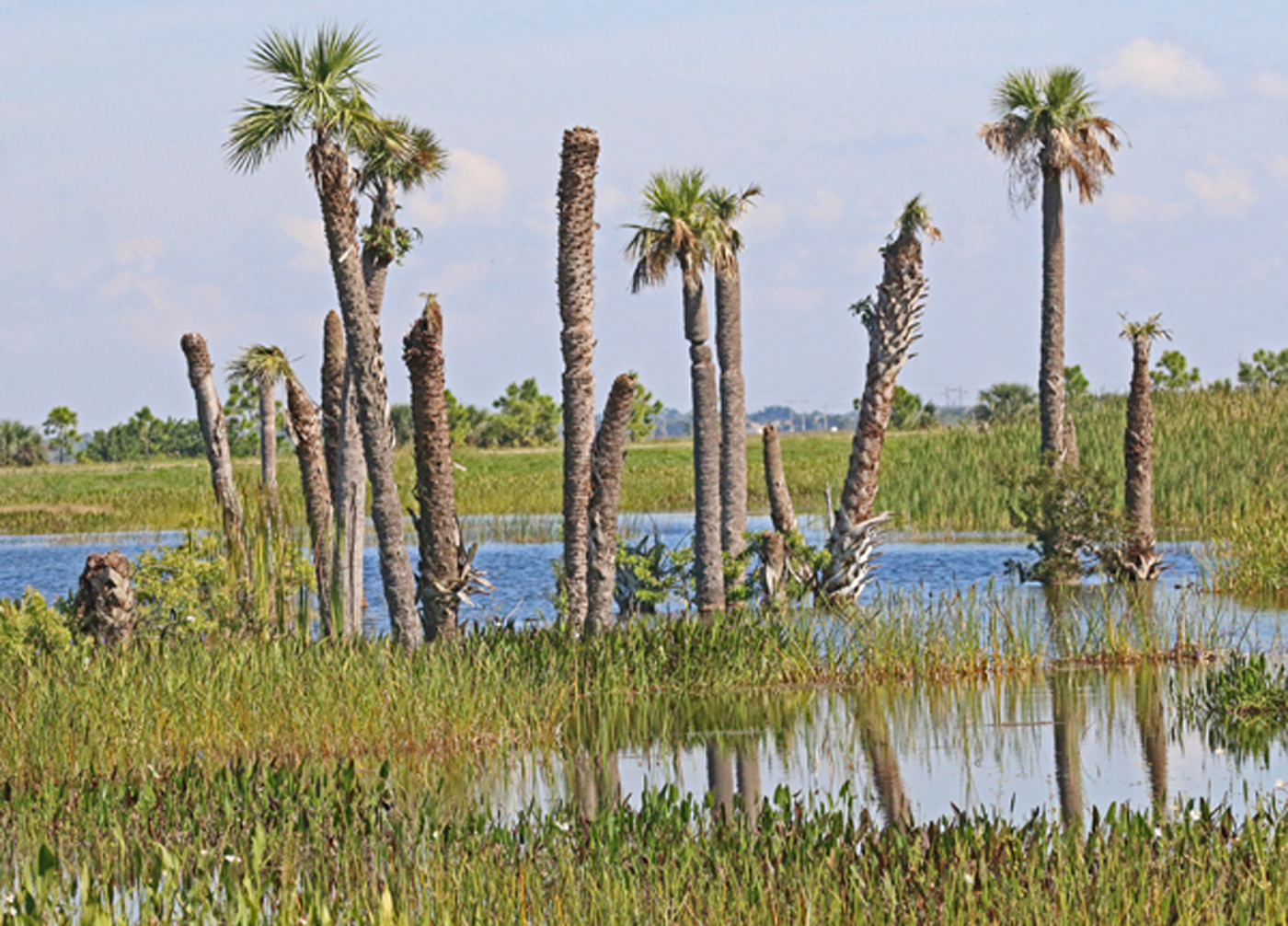
Typical constructed wetland habitat at the Viera Wetlands. (Photo Copyright Budd Titlow, NATUREGRAPHS)

If so, just grab your binoculars and camera gear and head to the Brevard County Wastewater Treatment Plant (BCWTP) located in the central Florida town of Viera, Florida—just 2.5 miles west of I-95. There you’ll find 200 acres of constructed wetlands that are supported and nourished by advanced treatment outflow from the BCWTP. You’ll also find some of the best and easiest wild bird watching and photography you’ve ever experienced. And—best of all—you can get great shots of everything you see with no more than a 300 mm lens (see the photos accompanying this article). No super-telephotos are needed here to get potentially prize-winning shots here!

At first blush, sewage and birds may still seem like an oxymoronic pairing. But such is not the case throughout our nation’s “Sunshine State.” There are 17 natural (both treatment and receiving) wastewater wetlands—totaling an estimated 6,200 acres—plus 21 constructed wetland sites—comprising roughly 4,000 acres—across the State of Florida.

Now here are some details about the specific set-up at Viera: In 1998, the Ritch Grissom Memorial Wetlands—more commonly and locally known as the “Viera Wetlands”—were created by transforming historic grazing land into cells—four in all—of deep and shallow marshland vegetation. Each of these constructed wetland cells now surrounds a small upland island of about one acre in size. Collectively, the four wetland cells also border a central lake habitat with a maximum depth of almost 30 feet.

Construction of this mosaic of natural habitats involved excavating the upland soil from the pastureland and using this material to create earthen berms that both contain and separate the marshland habitats. This earthwork also included emplacement of a system of pipes that connected the treated and polished effluent from the sewage treatment plant to the wetland cells.

Next came the installation of more than 200,000 plants—encompassing 19 native species—in the constructed wetland basins. Biologists specifically selected these plants to mimic the natural aquatic habitats found in central Florida. The four upland islands received an additional 2,600 native plant species—again chosen to emulate local natural habitats—including cypress hammocks, hardwood hammocks, and pine-hardwood forests. As an additional part of this habitat creation, mature longleaf pines and sabal palms were left in place to provide roosting and nesting structures for a variety of bird species.

Establishment of this multi-faceted central Florida wetland habitat has been a phenomenal success. The Viera Wetlands now provide living spaces for more than 160 species of birds, plus the birding and photography access is “as easy as pie”. A network of 2.4 miles of one-way, 10 mph gravel roads—perched atop the earthen berms—allows superb opportunities for virtually every square foot of the sanctuary.

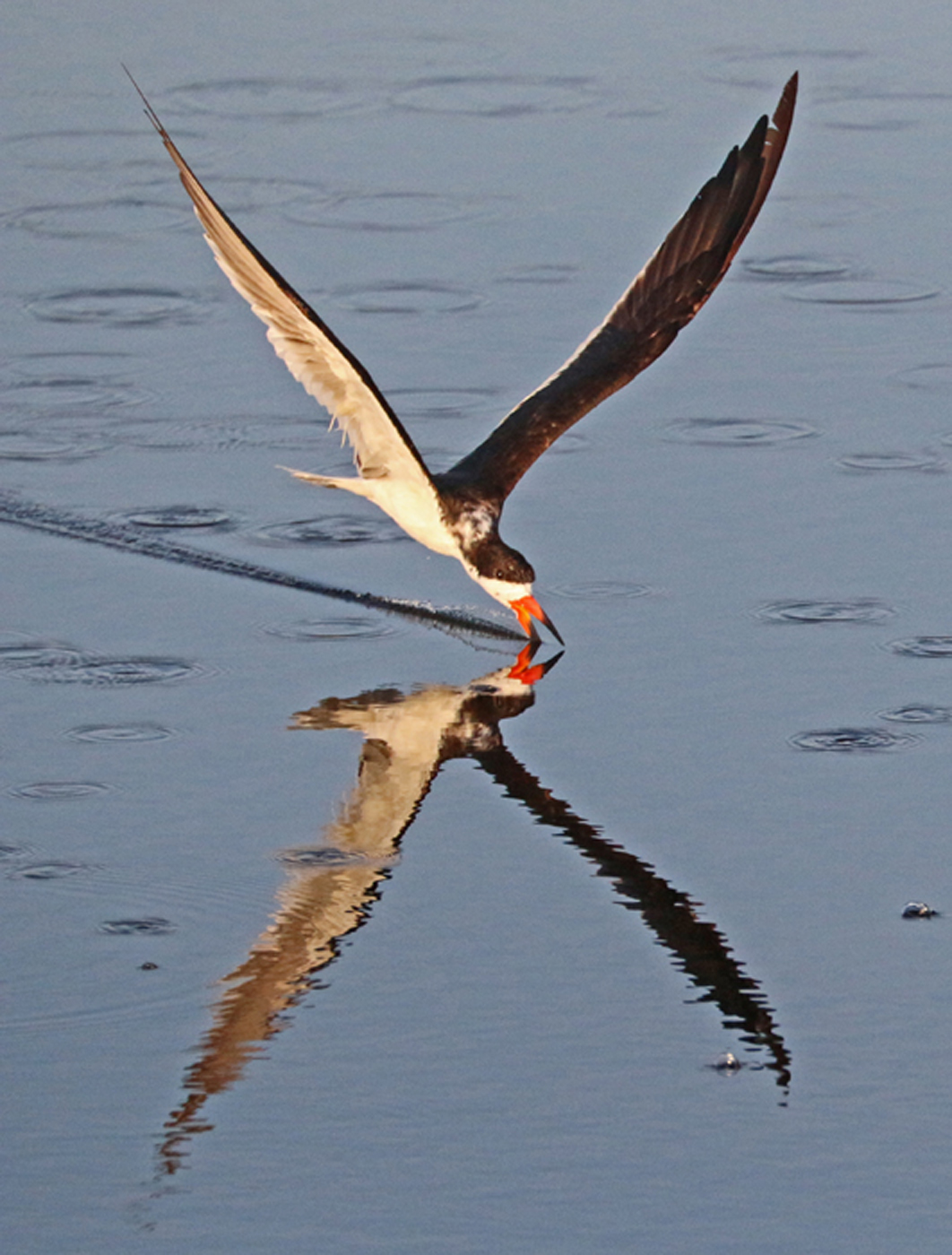
To illustrate just how good Viera is, let me describe one of my recent spring visits: I arrived at the sanctuary just after sunrise and spent an hour watching/photographing black skimmers as they soared just above the water’s surface with their beaks slicing artfully through the water. The contrast of the dark water and beautiful morning light on the birds produced my first “life shots” of the day.

Photo #2-Skimmer at Work
A Black Skimmer plies its craft just after sunrise in the Viera Wetlands. (Photo Copyright Budd Titlow, NATUREGRAPHS)

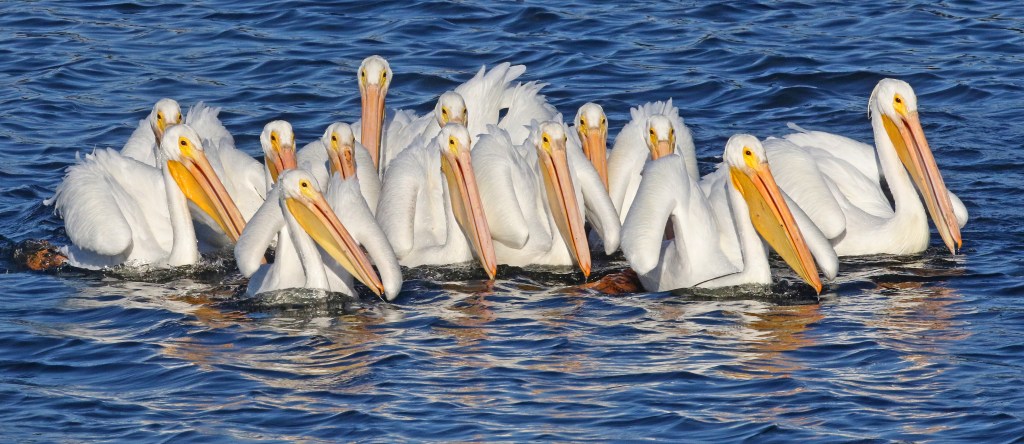
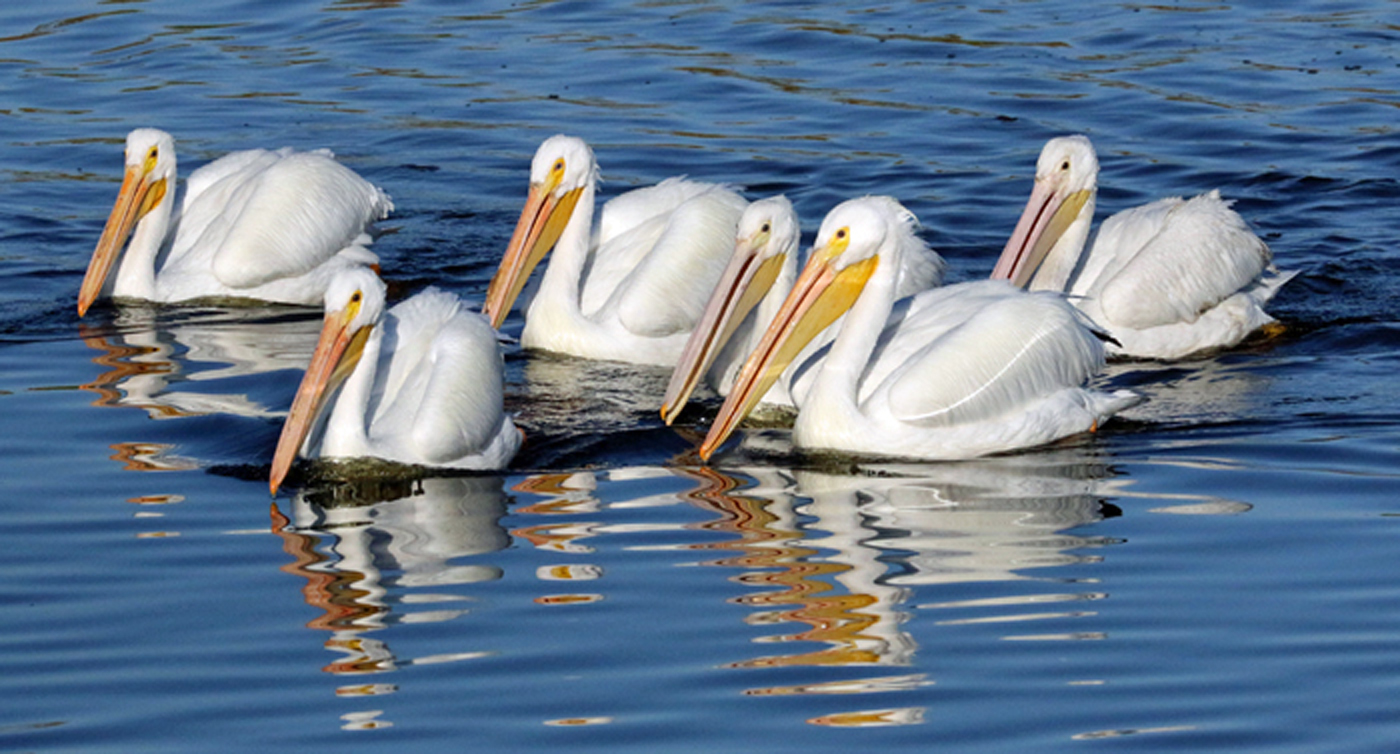
Next I drove to the adjacent cell where I found a flock of twelve white pelicans moving in a choreographed avian ballet. I was in heavenly bliss as these magnificent birds demonstrated their classic feeding behavior right before my eyes. First, all of the pelicans gathered together in a tight group and then broke out—swimming in a single line. They continued this “follow-the-leader” action for a few hundred feet until the first bird turned perpendicular to the rest. Taking this cue from their leader, the rest of the pelicans swam into a semicircle and then immediately ducked their heads in unison and scooped up the fish they had been herding.

Photo #3-White Pelican Feeding Group
A feeding group of White Pelicans looks for fish to herd in the Viera Wetlands. (Photo Copyright Budd Titlow, NATUREGRAPHS)

I suppose you could say that one of the “problems” with Viera is that you have to move on from each spectacular avian display because you know that there is something equally as good going on right around the corner. And my next subject certainly didn’t disappoint.

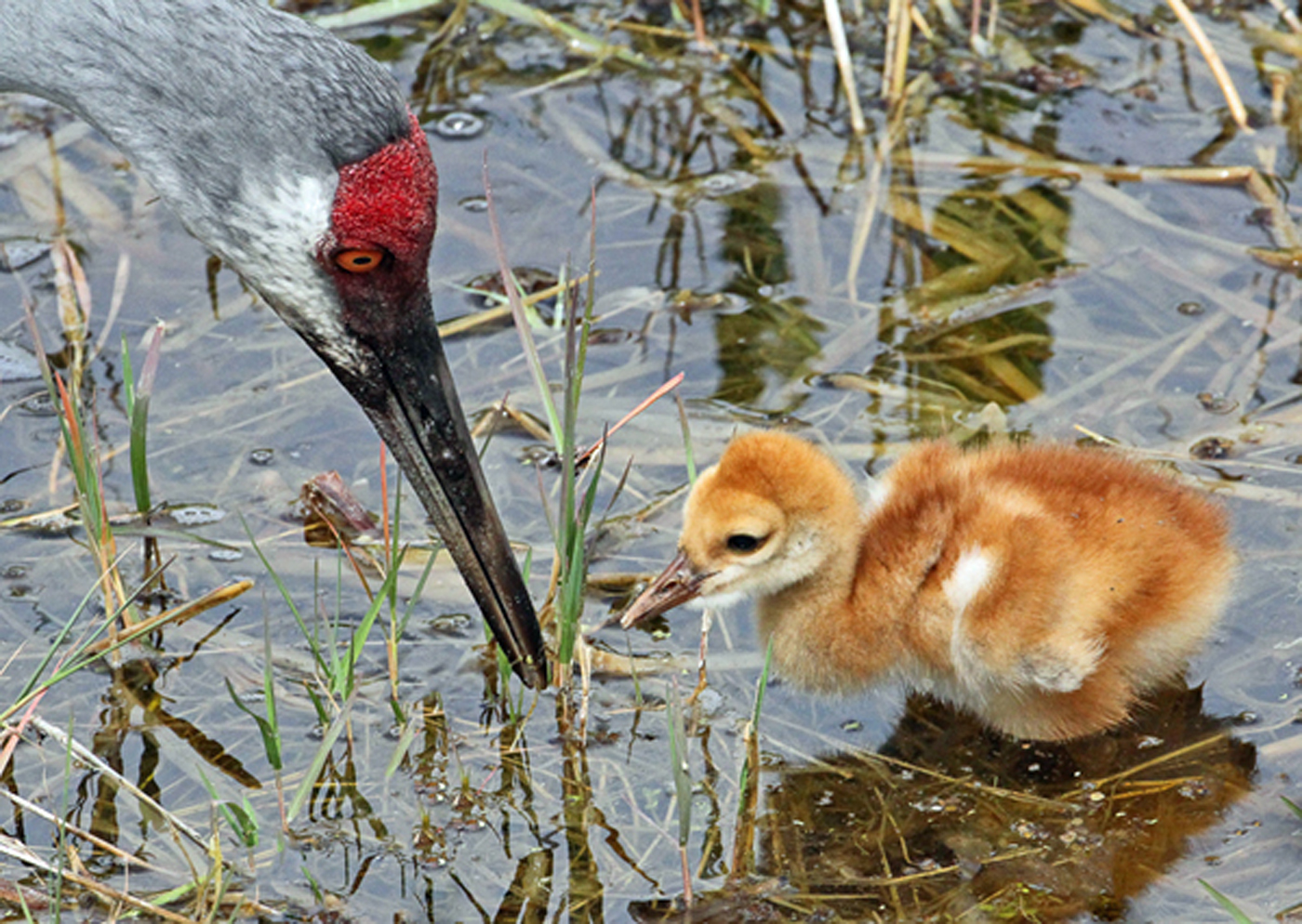
Driving just a few hundred yards further, I came upon a cluster of people training their binoculars and lenses on a pair of huge long-legged, gray birds with bright red caps. As I watched these proceedings, I realized that these birds were sandhill cranes. While living in Colorado, I experienced sandhill cranes many times—most notably during their springtime migration phenomenon along the Platte River in Nebraska. But this was my first encounter with Florida’s very own subspecies of sandhill crane.

Photo #4-Sandhill Crane Adult Feeding Chick
A Florida Sandhill Crane feeds its chick in the Viera Wetlands. (Photo Copyright Budd Titlow, NATUREGRAPHS)

After leaving my car and blending into the group, I found an even bigger surprise. Each of the sandhill adults was busily teaching two tiny yellow chicks how to feed. As with most birds at Viera, the sandhills paid us absolutely no mind while we all happily clicked away—getting full-frame shots from distances of less than 10 feet.

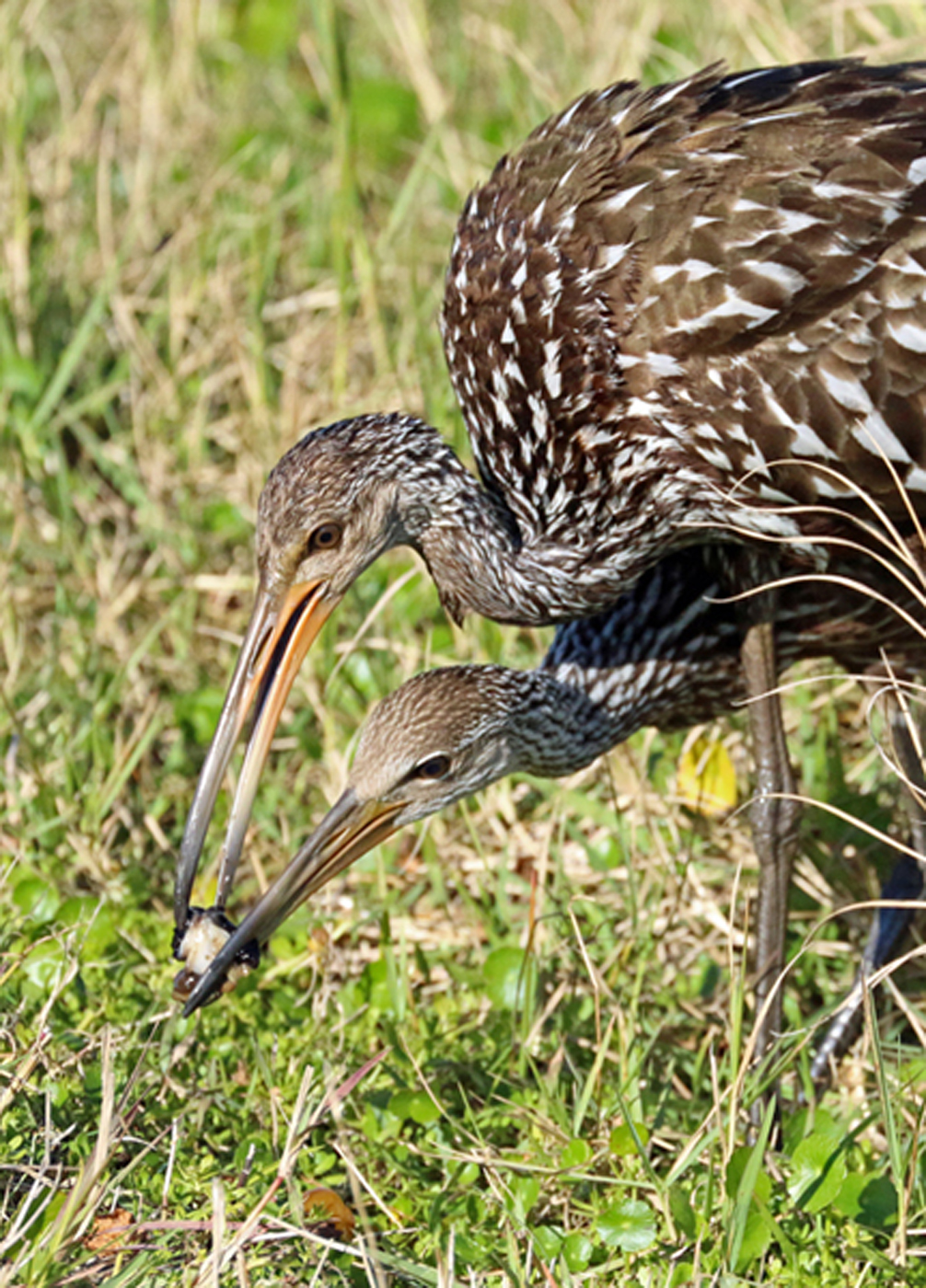
After an hour of watching and shooting, I contentedly moved on to the next gaggle of birders and photographers gathered along the roadside. Here I encountered my first limpkins—a classic native Florida bird which has disappeared from many of its original habitats in the state. As with the sandhill cranes, two limpkin adults were busily feeding their nearly fledged young. But this time, the feeding behavior was much more precise and focused. As I watched and photographed, each adult successively waded into the adjacent shallow marsh and emerged with a snail—the highly preferred food of these birds. Placing the snail shell on the ground, the adult limpkin then used its specially adapted beak to pluck out the snail meat. The next step involved feeding the extracted meat to its eager young protégé.

Photo #5-Limpkin Feeding Chick
A Limpkin adult teaches its almost-fledged chick how to extract the meat from a freshly-caught snail. (Photo Copyright Budd Titlow, NATUREGRAPHS)

During this same visit, I also watched a great blue heron catch and gulp down a greater siren—an eel-like salamander that had to be at least two feet long. Plus I had the pleasure of seeing a great egret repeatedly using a dazzling “dancing routine” to scare up small fish which it then consumed.

Now here’s the best part of these constructed wetlands—like Viera—from a climate change standpoint: All types of wetlands—from temperate freshwater marshes to boreal peatlands—are carbon-sequestering systems or “carbon sinks.” This means that wetlands have the ability to store excess carbon—via photosynthesis—from our atmosphere. So, the more wetlands—sewage and otherwise—we create across our landscape, the better off we are going to be in our battle against climate change!

To summarize, most outdoor advocates realize that the State of Florida is one of the best places on the planet for watching and photographing wild birds. (After moving back here six years ago, I soon had enough high quality material to publish a hard cover book on the subject.) And—from every perspective—the Viera Wetlands are the best place I’ve found in Florida for both fabulous birding and photography. It’s all right there waiting for you—an amazing diversity of bird life, great natural settings, easy driving access, unflappable subjects, plus a plethora of restaurants and hotels within a three mile radius. Plus the Merritt Island National Wildlife Refuge and its widely celebrated “Black Point Drive” is only a 30-minute drive away.

So go for it—plan a trip to Viera, Florida and watch/photograph wild birds to your heart’s content. Just make sure you take some extra socks—you’re definitely going to need them!

Photo credits:   Copyright Budd Titlow, NATUREGRAPHS (ALL)

 Author’s bio:     For the past 50 years, professional ecologist and conservationist Budd Titlow has used his pen and camera to capture the awe and wonders of our natural world. His goal has always been to inspire others to both appreciate and enjoy what he sees. Now he has one main question: Can we save humankind’s place — within nature’s beauty — before it’s too late? Budd’s two latest books are dedicated to answering this perplexing dilemma. PROTECTING THE PLANET: Environmental Champions from Conservation to Climate Change, a non-fiction book, examines whether we still have the environmental heroes among us — harking back to such past heroes as Audubon, Hemenway, Muir, Douglas, Leopold, Brower, Carson, and Meadows — needed to accomplish this goal. Next, using fact-filled and entertaining story-telling, his latest book — COMING FULL CIRCLE: A Sweeping Saga of Conservation Stewardship Across America — provides the answers we all seek and need. Having published five books, more than 500 photo-essays, and 5,000 photographs, Budd Titlow lives with his music educator wife, Debby, in San Diego, California.